You know what you wish you had said, but the words arrive after the argument. During the conversation, you raised your voice, gave in, sent several messages, walked away, or went completely quiet. Once the intensity dropped, the situation became easier to understand.
This is often the most frustrating part. You understand your attachment history and recognize the pattern each time it happens. You even know which communication skills or breathing practices would help. Yet in the moment itself, the reaction begins before you notice it.
The Return works with what happens before the words or behavior. You learn to recognize the nervous-system state behind the reaction, influence that state before the impulse becomes an action, and decide what you want to do next.
The problem you recognize
The familiar sentence
“I did exactly what I said I would not do.”

A woman rarely describes this by saying, “I noticed my automatic response too late.” She says she did it again. She is left with a knot in her stomach, replaying the same conversation and finding the words she could not reach while it was happening.
She reacts and then regrets it. She raises her voice, accuses her partner, demands an answer, or sends a message too quickly. Later, she knows exactly what she wanted to say.
Or she shuts down when she needs to speak. She freezes, leaves, or becomes silent. The conversation ends, but she continues it in her mind for hours.
At other times, she agrees in order to preserve the connection. She says “fine” while feeling a clear “no.” The anger appears later and is directed at herself or her partner.
Control has its own version. She checks, insists, or asks for an immediate answer. The pressure creates more distance and seems to confirm the fear that started the reaction.
Afterward, she can usually see more nuance. She promises herself that the next conflict will be different. But a promise made while calm is not always available when the same situation happens again.
A reaction that started earlier
Jani remembers telling her therapist, “I do not want to shout anymore,” after a difficult moment in her relationship. She was focused on the end of the scene: her anger had risen quickly and she had shouted. Her therapist asked a different question: “What happened just before you raised your voice?”
That question revealed several things Jani had not noticed at the time. A gesture from her partner had felt dismissive. Her breathing changed and her body tightened. She felt unimportant and unable to say what she needed to say. The urge to shout came after those changes.
The shouting was the visible action. The reaction had already begun.
What happens before the action
Consider a familiar situation: your partner does not answer, seems distant, or withdraws from the conversation. You quickly interpret what it means. The thoughts arrive fast: “He does not love me anymore,” “I did something wrong,” “He is going to leave,” or “My needs are too much.”
Physical changes follow, or appear at almost the same time. Your chest tightens. Your jaw contracts. Your breathing becomes shorter or stops for a moment. Fear, shame, hurt, or anger becomes stronger. Then an impulse appears: ask for reassurance, attack, fix the situation immediately, give in, leave, or disappear emotionally.
The nervous-system response does not always look agitated. Mobilization moves toward action: the jaw tightens, speech speeds up, and the hand reaches for the phone. Freeze interrupts action while the person remains alert. Shutdown looks different again: the shoulders drop, the mind goes blank, the voice disappears, and the body feels heavy. Each state needs a different intervention.
This whole sequence is the pattern. The behavior is only the part that you and the other person can see.
THE AUTOMATIC SEQUENCE
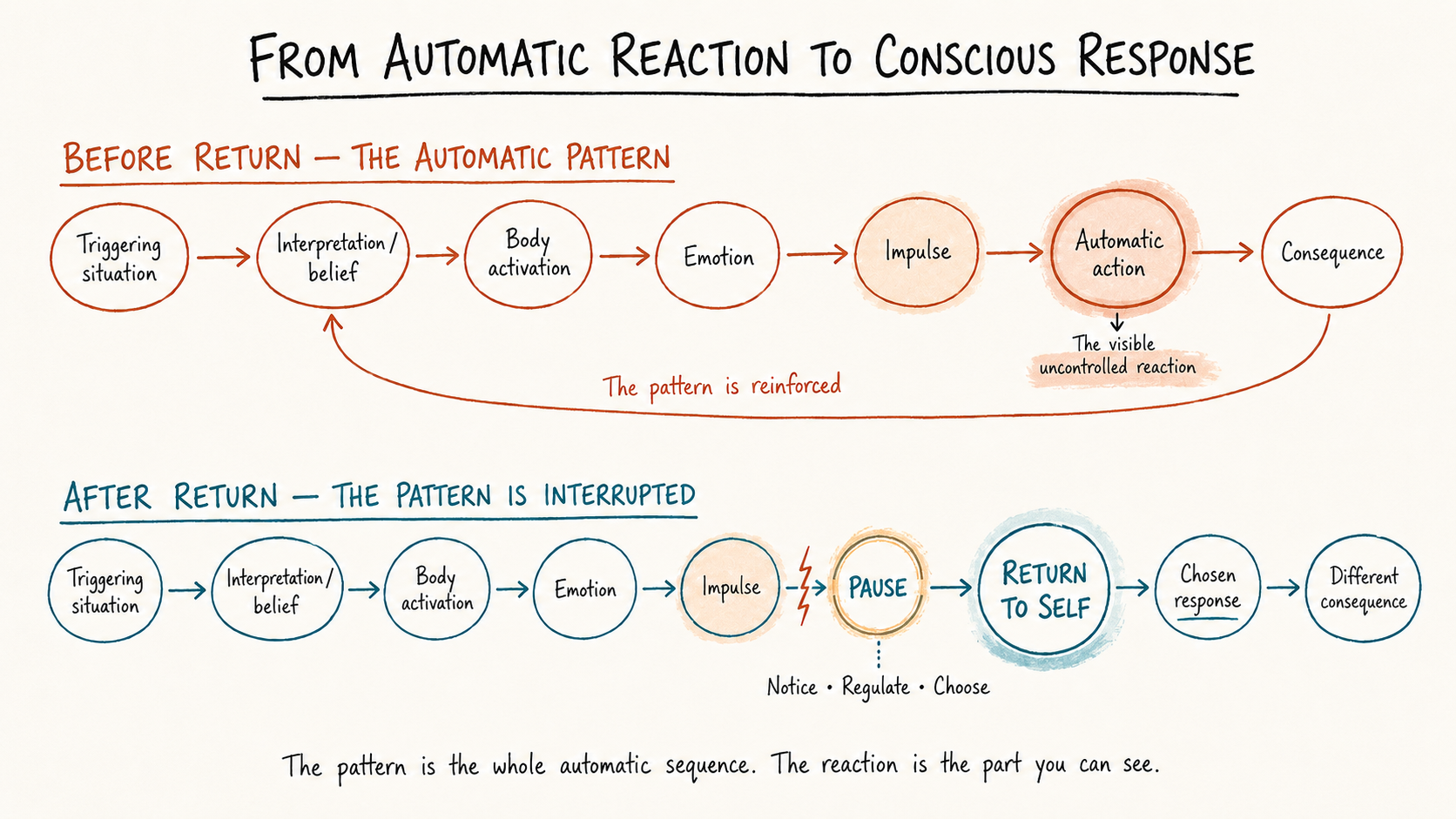
The action often reduces discomfort in the short term. A reply after ten messages lowers anxiety. Giving in ends the argument. Leaving ends the pressure of the conversation. That immediate relief makes the same response more likely to appear again. The longer-term cost is shame, resentment, distance, or stronger evidence for the original belief.
An automatic reaction does not prove that something is wrong with you. It is a learned response that once helped you manage threat, conflict, or disconnection. The difficulty begins when it becomes the only response available, even when the present situation requires something else.
The nervous system before the reaction
The autonomic nervous system changes the body before a deliberate response is formed. Breathing, heart rate, muscle tone, attention, and readiness for action shift quickly. When a partner’s silence, expression, tone, or withdrawal has become associated with rejection or danger, the response can begin before you have worked out what the moment actually means.
There is more than one defensive state. Mobilization prepares the body to act and shows up as arguing, chasing, fixing, controlling, or leaving. Freezing is not calm; movement is inhibited while attention remains highly alert. A more collapsed state reduces energy and access to speech or action. These states overlap, and a person can move from one to another during the same conflict (Kozlowska et al., 2015; Roelofs, 2017).
The somatic work in The Return starts by identifying that change of state in a recent conflict. We slow the event down and reconstruct it in order. What happened to your breath? Did your body move forward, hold still, or collapse? Did your eyes narrow? Did your voice become louder or disappear? What action did your body prepare to take? The point is to recognize the state before focusing on the explanation.
Regulation means giving the nervous system new input and checking what changes. For mobilization, we test pressure through the feet or hands, deliberate movement, a wider visual field, contact with physical support, and a slower exhale. For freeze, we restore small voluntary movements, turn the head and eyes, use the voice, and reconnect with the room. For shutdown, we use a more upright posture, active movement, clearer sensory contact, and a fuller breath. The same breathing exercise is not used for every state.
We work below the point of overwhelm. The person moves briefly toward the difficult state, then back toward something more stable in the present. Repeating this develops greater flexibility between states. The goal is to recover enough access to speech, thought, and choice to respond without immediately following the old impulse.
Why understanding is not enough under stress
You have read about attachment, identified the source of your fear, and learned to slow down, check your assumptions, and state what you need. You understand it when you are calm. Accessing that knowledge becomes harder when emotional intensity rises.
Executive functions help us hold a longer-term goal in mind, inhibit an immediate response, compare alternatives, and anticipate consequences. Strong stress does not switch these functions off completely, but it can impair the prefrontal networks involved in working memory and flexible control. Familiar responses remain easier to access, which helps explain the honest feeling that “I could not do anything else in that moment” (Arnsten, 2009).
Research on response inhibition makes a useful distinction between reactive control and proactive control. Reactive control stops an action after the impulse has begun. Proactive control uses earlier cues to prepare before the action starts (Aron, 2011; Bari & Robbins, 2013). Both matter here. At first, you hear yourself raising your voice and stop mid-sentence. Later, you recognize the tight jaw, held breath, or urgent thought that usually comes before it.
Practice has to begin at an intensity where some choice is still available. A new skill is difficult to retrieve for the first time when you are already overwhelmed. The Return therefore starts with smaller, more manageable situations and uses repetition to make the early signals easier to recognize in harder ones.
The pause between impulse and action
A first thought, a physical shift, and an impulse can appear without a deliberate decision. Still, “I want to shout” and “I shout” are not the same event. The interval is often brief, but it can be trained.
In a 2024 study from the University of St Andrews, couples completed a competitive reaction-time task. The winner of each round chose the intensity of an unpleasant sound delivered to the partner. Forced delays of 5, 10, or 15 seconds were associated with less negative emotion and less reactive aggression. The study included 81 couples across the main experiment and replication, and the researchers did not find a clear advantage for the longer delays over the five-second delay (McCurry, May, & Donaldson, 2024).
This was a laboratory task, not a real argument. The samples were relatively small and mostly young, and the experiments were not preregistered. The findings apply to low-level reactive aggression, not intimate partner violence. They do, however, support a modest and relevant point: even a short delay before action can change what happens during a provoked interaction.
The pause in The Return is not empty waiting. It is the time used to notice the state, reduce enough activation to remain present, and decide what response fits the situation. The method is summarized as Notice · Regulate · Choose.
WITH THE RETURN
What breathing can and cannot do
Breathing practices can influence physiological arousal. In a randomized study, five minutes of structured breathing each day for one month improved mood and reduced respiratory rate. The exhale-focused cyclic sighing condition produced the strongest results among the breathing practices tested (Balban et al., 2023). A meta-analysis of 223 studies found increases in vagally mediated heart-rate variability during slow breathing, immediately afterward, and after repeated practice (Laborde et al., 2022). A separate review also reported autonomic changes while noting substantial differences between study methods (Zaccaro et al., 2018).
Breathing does not identify the meaning you assigned to your partner’s silence, decide whether a boundary is needed, or speak that boundary for you. You also have to notice the reaction early enough to remember the practice. A brief mindfulness intervention in smokers changed one EEG measure related to response inhibition but did not improve behavioral performance on the task, a useful reminder that a physiological or neural change does not automatically become a different action (Andreu et al., 2018).
The choice of strategy also depends on intensity. In laboratory studies, people preferred cognitive reappraisal more often at lower emotional intensity and distraction more often at higher intensity (Sheppes et al., 2011). The practical difference is straightforward. During manageable activation, examining an interpretation is still accessible. At a higher intensity, stepping away and returning later is easier than trying to analyze the situation while overwhelmed.
Regulation should not become suppression. The purpose of slowing the reaction is to make it easier to say what matters, not to tolerate behavior that violates your limits. Gross’s work distinguished strategies used earlier in the emotional process from suppression used after emotion was already underway (Gross, 1998). In a study of 127 couples discussing a relationship conflict, suppression increased cardiovascular arousal and negative affect, while focusing on positive aspects of the relationship reduced them. The intervention given to one partner also affected the other partner’s experience (Ben-Naim et al., 2013).
Notice, Regulate, Choose
The central skill is noticing the change of nervous-system state before it becomes behavior. Notice, Regulate, Choose is the structure used to do that.
Notice
Notice begins with a real episode. You identify the first thought, the first physical change, and the direction of the impulse before the visible reaction. Naming the emotional state is one tool. In an fMRI study, affect labeling was associated with lower amygdala activity and greater activity in a right ventrolateral prefrontal region when participants viewed emotional faces (Lieberman et al., 2007). Naming the emotion does not end it. It gives you a more specific description than “I am losing control.”
Regulate
Regulation is matched to the state. You use breath, movement, vision, orientation, pressure, physical support, or an announced break to change the level and direction of activation. The practice is kept only when it brings back more contact, clearer thinking, and greater control over the next action.
A brief shift in perspective can also reduce intensity. In experimental work, self-distancing after provocation reduced angry feelings, aggressive thoughts, and aggressive behavior compared with analyzing the event from an immersed perspective (Mischkowski, Kross, & Bushman, 2012). In practice, this can mean describing the situation for a moment rather than continuing to argue from inside it.
Choose
The pause ends with a decision. The next response does not have to be dramatic. It can be a clear request, a limit, a question, or a break that includes a time for returning. Preparing that response in advance makes it easier to access. Research on implementation intentions shows that planned if-then responses can influence emotional action tendencies (Eder, 2011).
A personal plan can sound like this: “If I notice that I am holding my breath, checking my phone repeatedly, or feeling that I must get an answer now, I will put the phone down, name what I am feeling, and wait until I can make a clear request.”
During a conversation, the words are just as direct: “I can feel myself getting activated, and I do not want to say something that will hurt us. I need some time. I will come back to this at eight.”
Returning after an automatic reaction
There will still be moments when the old response appears. The work then is to notice what happened, take responsibility for the impact, and repair where possible. A reaction is information about the pattern, not a final judgment about your character.
What progress looks like
Progress is often visible in timing. You realize what happened after ten minutes instead of the next day. You hear your voice rising and stop. You notice your jaw before the shouting begins. You leave the message unsent long enough to decide whether it says what you mean. You state a need without giving it up or turning it into a threat. When you do react automatically, you return and address it sooner.
The Return does not train the disappearance of fear, anger, hurt, or impulse. It trains earlier recognition and greater flexibility in what happens next.
Conflict is not the same as abuse
This framework applies to automatic reactions and ordinary relationship conflicts where there is enough safety for choice and dialogue. When a relationship includes fear, threats, violence, coercion, or coercive control, the answer is not better self-regulation. Safety assessment and specialized support take priority. The authors of the couples study explicitly stated that their findings do not apply to domestic violence, and World Health Organization guidance places safety at the center of the response to intimate partner violence (McCurry et al., 2024; World Health Organization, 2013).
The point to remember
The action you regret has a beginning. Before the message, the accusation, the silence, or the decision to leave, there is an interpretation, a physical shift, an emotion, and an impulse.
The Return trains you to recognize that sequence earlier. You notice what is happening, use the pause to regulate, and choose what you want to do. At first, you see the pattern afterward. With practice, you begin to see it while it is happening, and eventually before the impulse becomes an action.
Scientific references and further reading
Andreu, C. I., Cosmelli, D., Slagter, H. A., & Franken, I. H. A. (2018). Effects of a brief mindfulness-meditation intervention on neural measures of response inhibition in cigarette smokers. PLOS ONE, 13(1), e0191661. https://doi.org/10.1371/journal.pone.0191661
Arnsten, A. F. T. (2009). Stress signalling pathways that impair prefrontal cortex structure and function. Nature Reviews Neuroscience, 10, 410–422. https://doi.org/10.1038/nrn2648
Aron, A. R. (2011). From reactive to proactive and selective control: Developing a richer model for stopping inappropriate responses. Biological Psychiatry, 69(12), e55–e68. https://doi.org/10.1016/j.biopsych.2010.07.024
Balban, M. Y., et al. (2023). Brief structured respiration practices enhance mood and reduce physiological arousal. Cell Reports Medicine, 4(1), 100895. https://doi.org/10.1016/j.xcrm.2022.100895
Bari, A., & Robbins, T. W. (2013). Inhibition and impulsivity: Behavioral and neural basis of response control. Progress in Neurobiology, 108, 44–79. https://doi.org/10.1016/j.pneurobio.2013.06.005
Ben-Naim, S., Hirschberger, G., Ein-Dor, T., & Mikulincer, M. (2013). An experimental study of emotion regulation during relationship conflict interactions: The moderating role of attachment orientations. Emotion, 13(3), 506–519. https://doi.org/10.1037/a0031473
Eder, A. B. (2011). Control of impulsive emotional behaviour through implementation intentions. Cognition and Emotion, 25(3), 478–489. https://doi.org/10.1080/02699931.2010.527493
Gross, J. J. (1998). Antecedent- and response-focused emotion regulation: Divergent consequences for experience, expression, and physiology. Journal of Personality and Social Psychology, 74(1), 224–237. https://doi.org/10.1037/0022-3514.74.1.224
Kozlowska, K., Walker, P., McLean, L., & Carrive, P. (2015). Fear and the defense cascade: Clinical implications and management. Harvard Review of Psychiatry, 23(4), 263–287. https://doi.org/10.1097/HRP.0000000000000065
Laborde, S., et al. (2022). Effects of voluntary slow breathing on heart rate and heart rate variability: A systematic review and a meta-analysis. Neuroscience & Biobehavioral Reviews, 138, 104711. https://doi.org/10.1016/j.neubiorev.2022.104711
Lieberman, M. D., et al. (2007). Putting feelings into words: Affect labeling disrupts amygdala activity in response to affective stimuli. Psychological Science, 18(5), 421–428. https://doi.org/10.1111/j.1467-9280.2007.01916.x
McCurry, A. G., May, R. C., & Donaldson, D. I. (2024). Both partners’ negative emotion drives aggression during couples’ conflict. Communications Psychology, 2, 73. https://doi.org/10.1038/s44271-024-00122-4
Mischkowski, D., Kross, E., & Bushman, B. J. (2012). Flies on the wall are less aggressive: Self-distancing ‘in the heat of the moment’ reduces aggressive thoughts, angry feelings, and aggressive behavior. Journal of Experimental Social Psychology, 48(5), 1187–1191. https://doi.org/10.1016/j.jesp.2012.03.012
Roelofs, K. (2017). Freeze for action: Neurobiological mechanisms in animal and human freezing. Philosophical Transactions of the Royal Society B: Biological Sciences, 372(1718), 20160206. https://doi.org/10.1098/rstb.2016.0206
Sheppes, G., Scheibe, S., Suri, G., & Gross, J. J. (2011). Emotion-regulation choice. Psychological Science, 22(11), 1391–1396. https://doi.org/10.1177/0956797611418350
World Health Organization. (2013). Responding to intimate partner violence and sexual violence against women: WHO clinical and policy guidelines. World Health Organization.
Zaccaro, A., et al. (2018). How breath-control can change your life: A systematic review on psycho-physiological correlates of slow breathing. Frontiers in Human Neuroscience, 12, 353. https://doi.org/10.3389/fnhum.2018.00353
Editorial note
This article is psychoeducational. It does not provide a diagnosis and does not replace psychotherapy, medical assessment, or specialized support in situations involving abuse. Examples have been anonymized.